Lancashire Fusiliers War Memorial
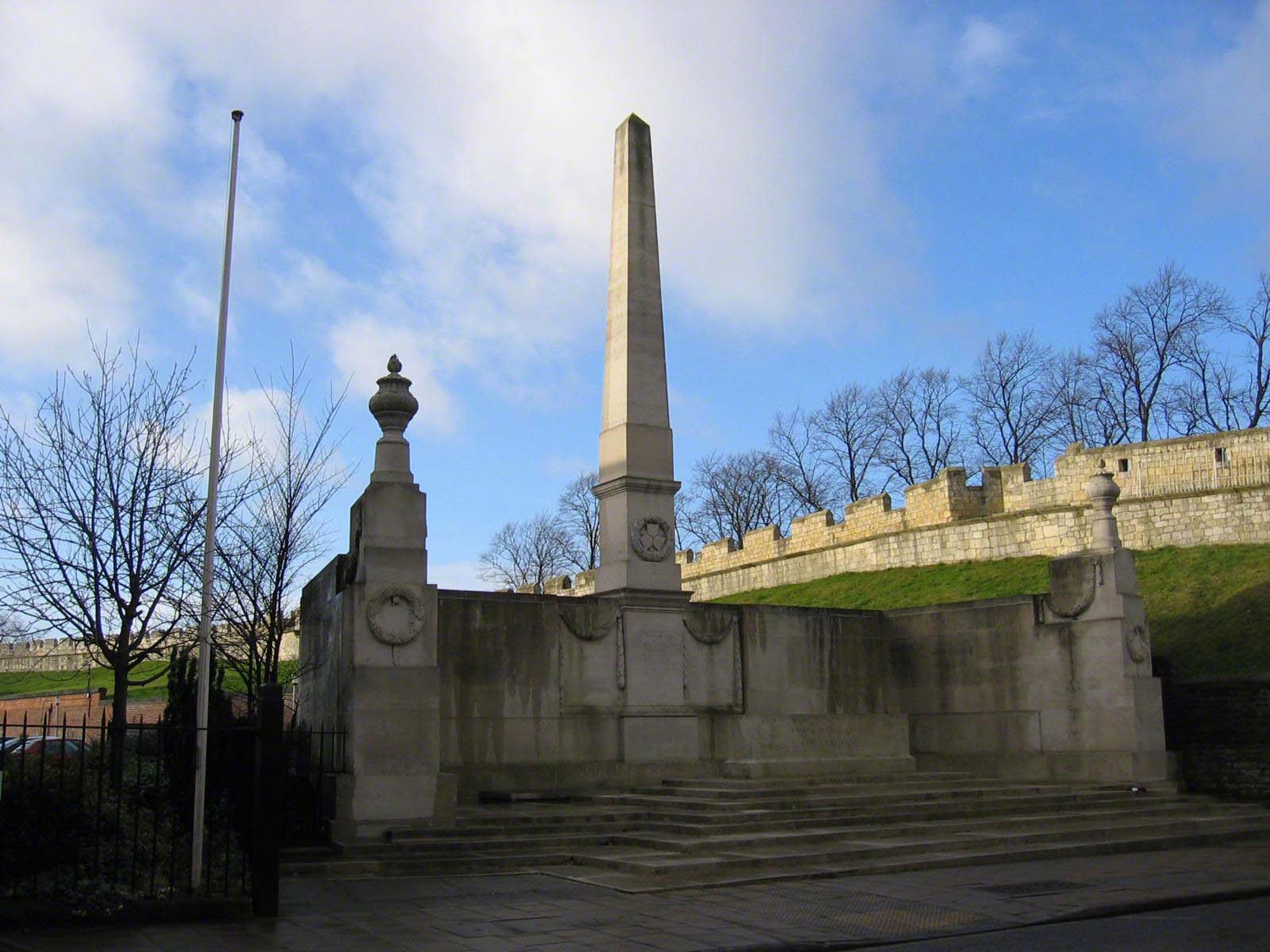
The Lancashire Fusiliers memorial at Bury, a 22½‑foot Portland‑stone obelisk on circular steps with finely carved and painted Union and regimental flags, was designed by Lutyens without fee because of his family ties to the regiment and unveiled on 25 April 1922, later being twice relocated within the town.
Description
Portland stone obelisk raised on rectangular pedestal with apsidal ends, standing on two circular steps and large circular base. Painted stone flags with Regimental and King’s Colours. Overall height 22ft 6.75in. Built by Messrs John Tinline of Bury Unveiled on 25 April 1922 by Lt-Gen Sir Beauvoir de Lisle, Commander in Chief, Western Command. Lutyens did not charge a fee as his father and great uncle had both served in the regiment. (Skelton, 2008, Appendix 1)
Memorial to the XXth Lancashire Fusiliers, Bolton Road. 1922, by Sir Edwin Lutyens. He declined a fee, being the son of Captain Charles Lutyens of the Regiment. Slim obelisk of Portland stone on an altar or sarcophagus plinth standing on a couple of shallow circular steps. The Union and Regimental flags are carved in stone but fully coloured, as at Rochdale, but this is more moving in its modesty than Lutyens’s municipal monuments. (Hartwell et al, 2005, p.183)
Lutyens had a family connection with the Lancashire Fusiliers: not only had his father served with the regiment but also his great uncle too (Major Englebert Lutyens was Napoleon’s Orderly Officer on St Helena). It was typical of Lutyens that, in such circumstances, he did not charge for his services.
The memorial is particularly noteworthy for its two splendid stone flags – the Union Flag and the regimental colours – both of which have gold ruffled fringes and tassles.
John Tinline, a local builder, made the memorial, which was unveiled on 25 April 1922 by Lieutenant-General Sir Beauvoir de Lisle, KCB, KCMG, DSO, Commander in Chief, Western Command. The date had a particular resonance for the regiment because, seven years earlier, it had been heavily involved in the Gallipoli Landings during which it earned the famous “Six VCs Before Breakfast”.
The memorial originally stood outside the regiment’s home, the Wellington Barracks on Bolton Road, and has been moved twice since. Firstly, in 1961 by 100 yards to accommodate a road widening scheme and, for a second time, in 2009 when it was positioned outside the new regimental museum in the town centre. (Contributor: Tim Skelton)
Bibliography
Gliddon, G. and Skelton, T.J. (2008) Lutyens and the Great War. London: Frances Lincoln.
Hartwell C, Hyde M & Pevsner N (2005) Lancashire: Manchester and the South East. The Buildings of England. New Haven: Yale University Press.
, Gliddon, G. and Skelton, T.J. (2008) Lutyens and the Great War. London: Frances Lincoln.