Holy Island War Memorial
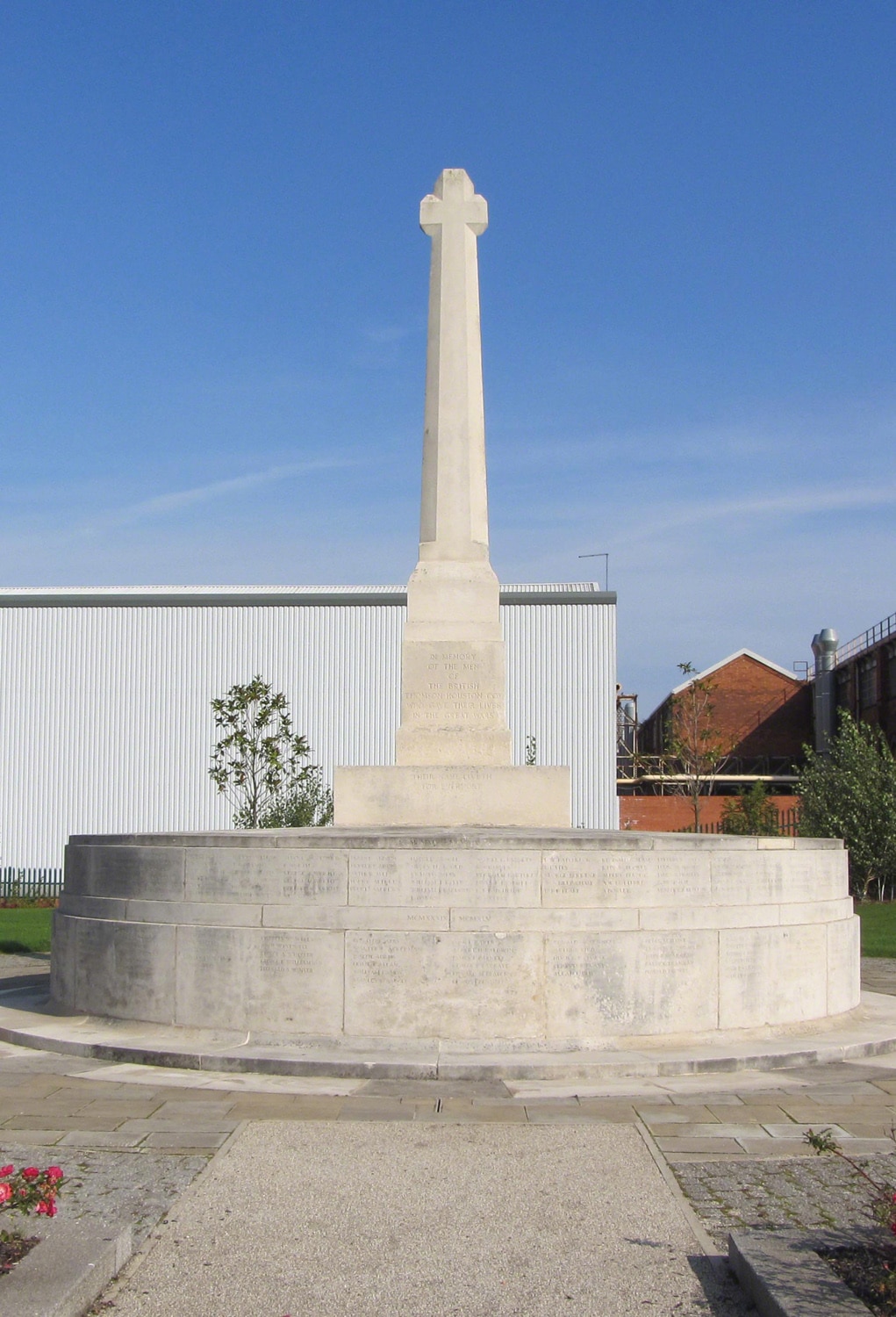
The Holy Island war memorial on The Heugh is a typical Lutyens stone war cross in pink ashlar, echoing nearby Lindisfarne Priory and Castle, its unusually heavy lettering suggesting he did not supervise construction, and it was unveiled in 1922 and repaired after storm damage in 1983–4.
Description
The windswept Holy Island off the coast of Northumbria offers the most dramatic location for one of Lutyens’s most celebrated works, the conversion of Lindisfarne Castle for his most loyal client Edward Hudson.
It is assumed that this connection led to the architect being asked to design the island’s war memorial, which is a typical simple Lutyens war cross, situated on The Heugh, with the Castle in the background across the bay. It is made of the same pink Doddington stone was used for the nearby Lindisfarne Priory. The heavy lettering on the memorial is not typical of the more delicate typeface that Lutyens usually chose for his memorials and is an indication that he did not supervise the actual construction. It had to be repaired in 1984 when the shaft split following expectionally strong winds during the previous winter.
The memorial was unveiled by Major Morley Crossman DSO on 4 June 1922. (Contributor: Tim Skelton)
War Cross on circular base made of pink ashlar. Unveiled on 4 June 1922 by Major Morley Crossman DSO. Snapped in half by winds during winter of 1983-4. Lutyens’s remodelling of the nearby Lindisfarne Castle for Edward Hudson, the proprietor of Country Life, is deservedly one of his most famous works.
(Skelton, 2008, Appendix 1)
Bibliography
Gliddon, G. and Skelton, T.J. (2008) Lutyens and the Great War. London: Frances Lincoln.
, Pevsner, N., Grundy, J., Ryder, P., McCombie, G., Welfare, H. (1992) Northumberland. The Buildings of England. New Haven: Yale University Press.