La Clytte Military Cemetery
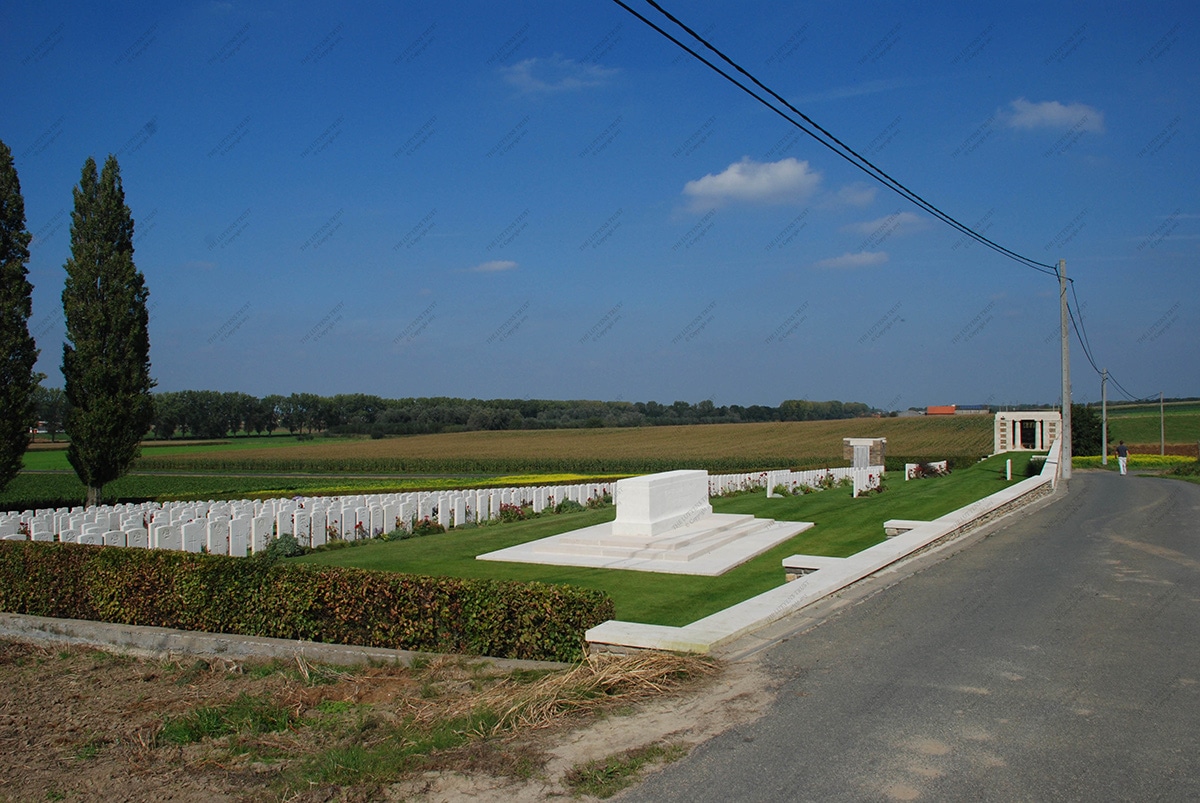
La Clytte Military Cemetery, originally begun in 1914 near brigade headquarters and later extended with battlefield burials, is an elongated, gently sloping enclosure of long south‑facing rows focused on an east‑side War Stone and apse‑set Cross of Sacrifice, approached obliquely between paired brick‑and‑stone entrance shelters.
Description
De Klijte was used as the brigade headquarters. The first graves date from as early as 1 November 1914. After the war, the cemetery was extended with graves from the battlefield and from smaller cemeteries in the vicinity.
The elongated cemetery has six plots, the earliest of which are at the far end, which means that the cemetery has been extended in the direction of the entrance. All graves face south, in line with the first graves. The length of the cemetery is accentuated by the long continuing rows. The War Stone is on the side of the entrance, on the east side, as advocated by Lutyens. The Cross of Sacrifice is at the far end, in an apse-shaped space that has been added to the rectangular cemetery. Visitors looking closely will notice that the principal axis is not in an exactly central position between the middlemost graves, but between the middle- most headstones. The height adjustments in the wall sur- rounding the cemetery clearly show that the front part of the ground rises and that the top part levels out again. From the entrance only the top of the Cross of Sacrifice is visible (cf. Villers-Bretonneux).
The two entrance buildings prevent the visitor from entering in line with the principal axis and having to walk around the War Stone to come to a grave. As a result, the War Stone is clearly visible from the road. The entrance buildings have been raised in a combination of brick and a plinth, cordon and roof edge of white stone. As the road is slightly sloping, a few steps have been added near one of the shelters. There are a strip of lawn and two white plateaux in front of the cemetery. In addition, a storage space has been incorporated in the wall halfway into the cemetery. (Geurst, 2010, p.243)
Bibliography
Geurst, J. (2010) Cemeteries of the Great War by Sir Edwin Lutyens. Rotterdam: 010 Publishers.
,